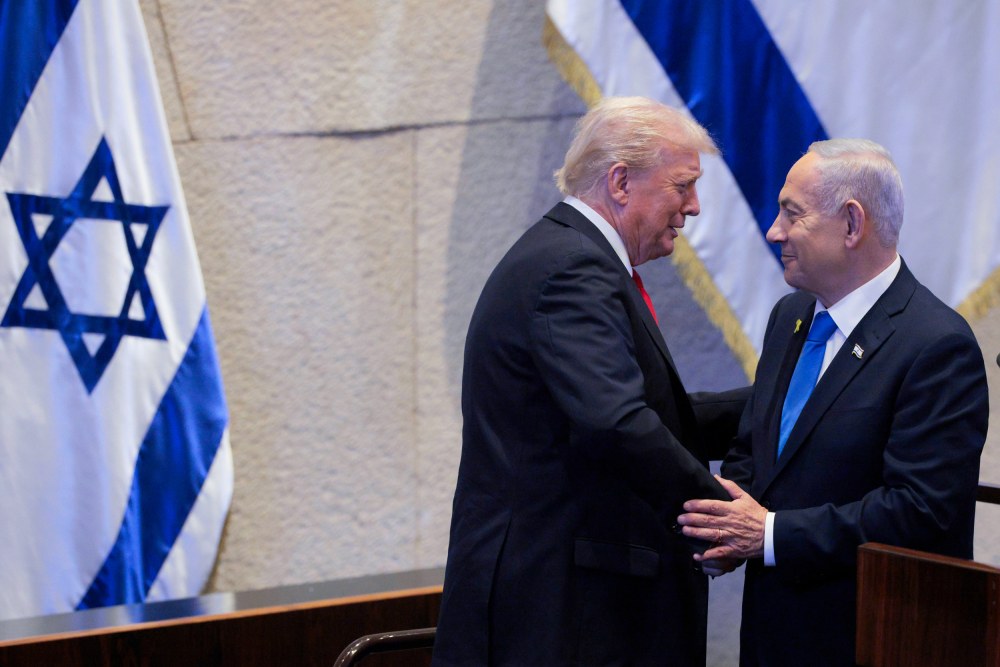

Trump is not just improvising foreign policy but systematically trading away U.S. influence.
Sections Sections Alaska News Politics Opinions Sports Talk to us Opens in new window Newsletters Opens in new window Donate to ADN today Close Subscribe Log in/Log out Opens in new window Donate to ADN Opens in new window Games All content Business/Economy Show Business/Economy sub sections Energy Alaska News Show Alaska News sub sections Anchorage Mat-Su Rural Alaska Education Science Wildlife Aviation Military Crime & Courts Politics Show Politics sub sections Alaska Legislature ADN Politics Podcast Opinions Show Opinions sub sections National Opinions Editorials Letters to the Editor Nation/World Arts and Entertainment Show Arts and Entertainment sub sections Books Film and TV Music Outdoors/Adventure Sports Show Sports sub sections High School Sports UAA Athletics Skiing Hockey National Sports Alaska Life Show Alaska Life sub sections Food and Drink Travel Gardening Advice Lawless Visual Stories Iditarod Alaska Journal of Commerce Opens in new window The Arctic Sounder The Bristol Bay Times e-Edition Today's Paper Opens in new window Obituaries Legal Notices Opens in new window Calendar Events Show Events sub sections Peak 2 Peak Events Opens in new window Educator of the Year Opens in new window Celebrating Nurses Opens in new window Top 40 Under 40 Opens in new window Alaska Spelling Bee Opens in new window Alaska Craft Brew Festival Best of Alaska Spring Career Fair Opens in new window Achievement in Business Youth Summit Awards Promotions Show Promotions sub sections Best of Alaska Voting Giveaway AK Scottish Highland Games Giveaway 2026 Special Sections Show Special Sections sub sections 2026 Summer Camp Guide Opens in new window 2025 Best of Alaska Opens in new window Alaska Visitors Guide 2026 Opens in new window Alaska Health Care Opens in new window 2025 Emergency Preparedness & Safety Opens in new window Senior Living in Alaska Opens in new window Alaska Visitors Guide ADN Store Opens in new window Reprints Marketplace Show Marketplace sub sections Classifieds Opens in new window Jobs Opens in new window Place an Ad Opens in new window Contact Us Show Contact Us sub sections Customer Service Advertise Careers at ADN Opens in new window Sponsored Content Archives Newspapers.com archives Opens in new window e-Edition Today's Paper Opens in new window Games Opens in new window Obituaries ADN Store Promotions Sponsored Content Opens in new window Gift subscriptions Opens in new window Manage account Opens in new window Obituaries Games Opens in new window ADN Store Opens in new window e-Edition Today's Paper Opens in new window Sponsored Content Opens in new window Promotions Gift subscriptions Opens in new window ADVERTISEMENT ADVERTISEMENT Opinions Opinion: The unilateral disarmament of American diplomacy By Bruce Botelho Published: 14 hours ago President Donald Trump talks with reporters before boarding Air Force One at John F. Kennedy International Airport in New York, early Tuesday, June 9, 2026. (AP Photo/Mark Schiefelbein) Few of us have occasion to think about the crucial role that our career diplomats and foreign service officers play in defense of the United States. When they do their job well, they are largely unseen. They have been our permanent, trained representatives, empowered to speak for the nation, maintain communication, negotiate treaties, protect citizens abroad and manage crises short of war.
Under President Trump, we have sacrificed institutional knowledge and competence to a form of ad hoc diplomacy best illustrated by his use of his real estate developer friend Steven Witkoff and his son-in-law Jared Kushner to simultaneously negotiate three of the most intransigent foreign policy conflicts of the era: the war in Gaza, the war in Ukraine and the war with Iran, once shuttling between negotiations in the latter two crises on the same day in Geneva. It would be unfair to say that the results speak for themselves, but it is fair to say that the transactional diplomacy that Witkoff and Kushner represent is a supreme disservice to our country’s long-term interests.
The Wall Street Journal recently reported that more than 100 ambassadorships are currently vacant, exacerbated by Secretary of State Marco Rubio’s decision to recall some 30 career ambassadors.
Presidents have historically rewarded close friends and large donors with certain diplomatic posts. These can be seen as strategically important for both the president and the host nation: a person having strong personal connections to the president. Some of Trump’s choices suggest that the country is perhaps better served by leaving the ambassadorship vacant and keeping the administration’s disdain for the host a matter of conjecture rather than confirmation: Billy Long proposing that Iceland become the 52nd state; Jared Kushner’s father, Charles , interfering in a court proceeding, leading to a temporary ban on consultations with the French government; and television personalities like Donald Trump Jr.’s ex-fiancée Kimberly Guilfoyle , to Greece, and Kari Lake , to Jamaica.
More alarming is the decimation of the ranks of foreign service officers . Since Trump returned to office, nearly 25% of the officer corps has left the service, either having resigned, retired or been forced out. This loss of capacity — to deal with foreign counterparts or provide in-depth analysis — severely weakens our nation’s ability to project soft power. It is not easily replaced.
The foreign service is sometimes described as an apprenticeship program. Competition to join is fierce and has historically attracted the nation’s brightest college graduates, who are given increasingly challenging assignments in the field or in Washington, D.C., as a condition for advancement. Now, having risen through the ranks, senior officers with expertise in arms control, energy and regional politics have been replaced with players having thinner resumes or no one at all. A corps that prided itself on its nonpartisan representation of the nation is being conditioned to serve more partisan interests.
Into this space, Trump has inserted a two-man team consisting of his son-in-law and his longtime real estate associate. They are not Senate-confirmed, not embedded in any rigorous interagency process and not backed by the layered expertise that career diplomats once supplied. The “deals” they’ve tried to make reflect their own backgrounds and, perhaps, their own potential conflicts of interest.
How does one — with a straight face — argue that Gazans’ aspirations for peace center on becoming a new Riviera? Unsurprisingly, these efforts have produced few durable gains: a Gaza ceasefire that stalled, Ukraine negotiations that have not yielded any lasting settlement and, most dramatically, a failure to reach a new nuclear accord with Iran that preceded an escalation into open conflict that has engulfed the Middle East and wreaked havoc on the world’s economy.
The consequences of this diplomatic disarmament are all too clear. Trump’s transactional and often unpredictable approach has undermined our allies’ faith in our commitment to the rules-based order we once championed. When ambassadors are missing, assistant secretaries are gone and the person calling about a crisis is a presidential in-law with an investment fund, partners do what any rational actor does: diversify. They deepen ties to Europe, to regional powers, even to China, because America’s presence no longer feels steady or institutional.
Cutbacks in foreign assistance and diplomatic engagement are already creating humanitarian and governance gaps that rivals are moving to fill with their own money, media and mercenaries. The less Washington shows up in African capitals, in the Gulf and in contested parts of Asia, the more room Beijing, Moscow and others have to offer their own terms — less transparent but backed by diplomats who are actually there.
Trump is not just improvising foreign policy. He is systematically trading away the durable instruments of U.S. influence — career diplomats, embassies and alliances — for a tiny, personalized “deal team” of envoys like Kushner and Witkoff, who cannot carry the same strategic throw-weight.
The result is a United States that is quietly disarming itself in the realm where great powers win or lose without firing a shot.
Bruce M. Botelho is a former Alaska attorney general who served both Republican and Democratic governors. Initially appointed by Gov. Wally Hickel, he was subsequently retained as attorney general by Gov. Tony Knowles. He was born in Juneau, where he served four terms as mayor.
The Anchorage Daily News welcomes a broad range of viewpoints. To submit a piece for consideration, email commentary(at)adn.com . Send submissions shorter than 200 words to letters@adn.com or click here to submit via any web browser . Read our full guidelines for letters and commentaries here .
Bruce M. Botelho is a former Alaska attorney general who served both Republican and Democratic governors. Initially appointed by Gov. Wally Hickel, he was subsequently retained as attorney general by Gov. Tony Knowles. He was born in Juneau, and was Juneau mayor.
300 W. 31st Ave. Anchorage, Alaska, 99503