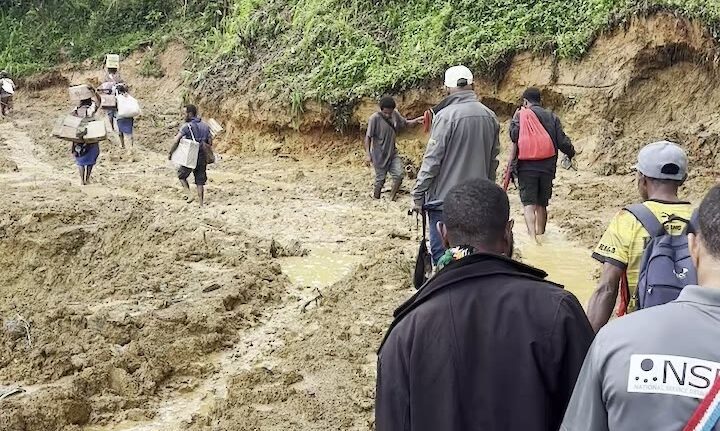
A research team travels the raw Connect PNG road into Anga's interior to assess frontline services. Schools hold firm and health workers persist, but the gap between road-building ambition and service delivery reality remains stark. About the author/s Kaintiba Research Team The Kaintiba Research Team for the PNG National Service Delivery Trends Assessment includes Jeremy Goro, Emmanuel Iga, Freddy Pupon, Buka Sari and Colin Wiltshire .
People in Kaintiba call their part of Anga’s interior “no man’s land.” Better services, for them, meant being able to stay. One line came up often when people talked about services: “We won’t need to go far. We will be treated here.” Schools, health clinics and village courts are operating. Communities keep them going. People live in scattered hamlets and come at intervals to the ples bung, gathering places, for markets and services. Bema, Kaintiba and Hawabango are three such places. We were based at Bema Catholic station while assessing service delivery in each of these locations. Kaintiba station is the local government centre for the area. An airstrip, a market, a health centre, a police station and a primary school are located there. It is not on the new Connect PNG road. It is reached from Bema on foot, along an older track. Clip 5: Walking between Bema and Kaintiba station. Morning. Clip 6: Walking between Bema and Kaintiba station. Returning after dark. Hawabango sits along the newly cut Connect PNG road extending out from Bema, still under construction during our visit. Road access has only recently reached parts of the interior, and movement is still conditional. At Bema, fuel drums blocked sections of the road. Works crews decided when vehicles could pass. Clip 7: Works vehicle struggling up the Connect PNG road. Clip 8: Excavator pushing raw earth at the road’s end near Hawabango. Beyond the last stable section, access continued on foot toward Hawabango. The road is only one part of the story here. Politics matters just as much. Thomas Opa, the Member of Parliament for Kerema Open, is from the coast and of mixed Motu and Australian heritage. Previous Members for Kerema Open were from Kaintiba and neighbouring Kotidanga. Pitom Bombom from 2007 to 2012, and Richard Mendani from 2012 until his passing in 2021. At the 2022 national elections, voters in these mountain stations did not vote for one of their own, but for a coastal candidate. A large share of Kerema District’s population lives in these mountain hamlets. Across the villages we visited, there was little visible infrastructure left from those earlier mountain MPs’ time in office. “Most of the people you see here voted for Opa,” one leader said. “We saw that he is an honest leader man, and we know he will deliver for us during his term. We have faith in him.” “Either you vote me or don’t vote me, I will still deliver the service,” another said, recalling his words. “He is fair for the mountain and coastal people.” At two of the three stations we visited, projects funded through PNG’s District Services Improvement Program were visible during his term. These included a new sub-health centre under construction at Hawabango and a school mess recently built in Bema with his support. In school, classes were underway. At morning assembly at Kaintiba station primary school, students lined up on the damp ground and sang before class. Teachers were present. Students moved into classrooms with notebooks and pens, sitting at worn desks. Clip 9: Morning assembly at Kaintiba station primary school, with students singing the national anthem. When asked how many students were learning at the right level, most parents and Grade 5 teachers said “most.” Several mentioned students were doing better than in other parts of Gulf. Most children continued on to Grade 9 or beyond. Teachers described their motivation as “very high,” tied to community support and a desire “to impart knowledge so children become better citizens.” Parents spoke of what education meant. “Education will give our children a better future,” one said. Another added that schooling would allow children “to find jobs and support the village and families.” When asked what affects learning, they named hunger and sickness, not behaviour. Those were also the main reasons students missed school. Teachers followed up when they did. Constraints were visible. “We are down three teachers because there are not enough teachers’ houses,” a teacher in Hawabango said. “We run multi-grade classes across all levels. We have six council wards and seven elementary schools feeding into us.” “More than two students share the same book,” another teacher explained. “We are given the syllabus and teachers’ guides, but we need to get standard based curriculum textbooks from Grade 3 to Grade 8.” Administrative distance affected everyday decisions. At Bema, the head teacher described what that meant in practice. “Our school account was frozen last year,” he said, after sourcing supplies through Lae without prior approval from the provincial office in Kerema. “Only this year it was reopened after our local priest intervened.” Supplies were now sourced through Lae. Classes continued. One teacher in Hawabango said: “I graduated from a registered teacher’s college and was posted here in 2022. To date, I have not received any pay. I love my community, so I keep teaching, depending on garden food.” The school day continued. Health services operated differently. At Kaintiba Health Centre, there was no running water. Dry buckets sat unused in the clinic. The Officer in Charge (OIC) spoke directly: “We are human beings like you. Why should we be treating people without water? Even to clean ourselves after treating infected patients. In other countries you would be sued for negligence working like this. I know the outside world. But we continue here with nothing.” Clip 10: Inside the ward at Kaintiba Health Centre, where patients sleep on the floor. For most families, there is no alternative care. “We only depend on the clinic,” one woman said. “When we don’t have cash, we bring food or firewood,” another explained. When complications arise, options narrow. Staff recalled two emergencies in the past few weeks. The first involved a twelve-year-old boy injured while helping his father collect breadfruit. “We stabilised him and called for a medivac,” the OIC said, “but it never came.” The community tried to carry him toward Lae. He died on the road. The second was a twenty-one-year-old mother who delivered her fourth child with a retained placenta. A medivac was again requested. “It would take two and a half days to walk to Kerema,” the OIC said. “She died, bleeding out.” This was not new. Before the new Connect PNG road, medical supplies were carried from the airstrip at Kaintiba station to Hawabango. “They would walk ten hours and bring them on their backs,” the health worker said. Construction of the new sub health centre followed the same pattern. “Each of the five wards provides labour,” a worker explained. “About 800 people carried the timber, cement, roofing iron and pipes.” Clip 11: Inside the health staff house at Hawabango. The road has brought promise. The MP is trusted. The schools hold firm. On market days, the OIC tells people plainly: “We are struggling. We do not have what we need to treat you.” Clip 12: Market day at Kaintiba station. A community member asks people to help bring solar, pipes and materials so the health centre can have water and electricity again. Life continues outside the clinic. When asked about childbirth, one woman said: “We find it hard for mothers in emergencies to move them to a better health centre … so most times mothers and babies die.” Jeremy Goro, Emmanuel Iga, Freddy Pupon, Buka Sari and Colin Wiltshire were the research team in Kaintiba for the PNG National Service Delivery Trends Assessment research. Kaintiba Research Team The Kaintiba Research Team for the PNG National Service Delivery Trends Assessment includes Jeremy Goro, Emmanuel Iga, Freddy Pupon, Buka Sari and Colin Wiltshire .